The elastic fleet advantage: Scaling e-commerce without scaling complexity


More online orders usually means more operational headaches. It doesn’t have to.
An elastic fleet is on-demand delivery capacity that expands and contracts with order volume, so a distributor doesn’t have to add trucks, drivers, or dispatch headcount every time online sales climb. The old assumption in distribution has been that revenue and operational complexity grow together, that doubling online orders means doubling the fleet, the routes, and the people managing them. That assumption doesn’t hold up, and the gap between the two is exactly where an elastic fleet earns its keep.
Why revenue and complexity don’t grow at the same rate
Revenue from e-commerce orders climbs in a straight line. Operational complexity doesn’t.
Every new online order adds a delivery window, a route decision, and a chance for something to go sideways: a wrong jobsite address, a customer who isn’t there for the drop, a load that doesn’t fit the day’s planned route. None of that shows up on a revenue report. It shows up in a dispatcher’s day, and it multiplies faster than the orders that caused it.
Picture a building materials branch that grows online sales 50% year over year. Revenue is up 50%. But the number of delivery windows, route combinations, and exceptions to manage didn’t grow by 50%, it grew by more, because each new order interacts with every other order already on the truck that day. Complexity compounds. Revenue adds. That mismatch is what breaks operations teams that scale their route planning around a fixed fleet instead of a flexible one. According to a ResearchAndMarkets report, North America’s last-mile delivery market is on pace to grow by more than $60 billion between 2023 and 2027, and little of that growth comes from distributors hiring proportionally more drivers.
What an elastic fleet actually means
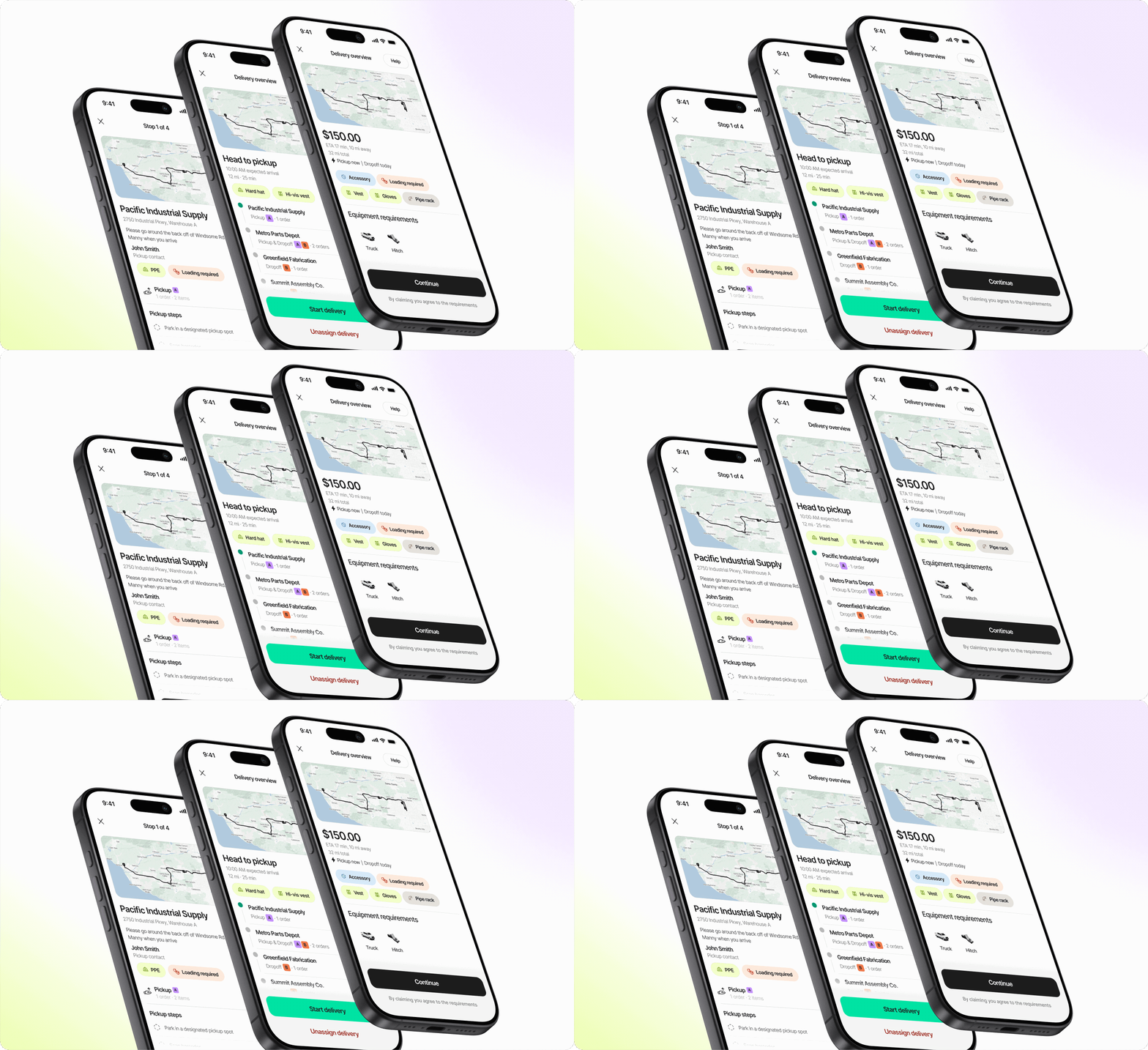
An elastic fleet is delivery capacity a distributor can flex up or down without owning it outright. Instead of buying a van and hiring a driver to cover a busy stretch, a branch taps a network of vetted drivers available on demand, then scales back down once volume settles. Curri’s fleet management tools let distributors blend their own drivers with that network, so the private fleet handles daily volume and the network absorbs the rest.
This matters most for e-commerce because order volume doesn’t arrive on a predictable schedule the way counter sales or contractor pickups do. A promotion, a competitor’s stockout, or a seasonal spike can double order volume in a week. A fixed fleet sized for average demand either sits idle most of the year or falls behind the moment volume spikes. An elastic fleet sized for actual demand does neither. For a wider look at this concept across construction supply chains, see Curri’s guide to elastic logistics for the trades.
Building in-house or leaning on a flexible network
The build-versus-lean decision comes down to how predictable a distributor’s e-commerce demand actually is.
A branch with steady, forecastable online order volume gets the most value from owning more of its fleet, because the utilization is there to justify the fixed cost of trucks and drivers. A branch with volume that swings with promotions, weather, or seasonality gets more value from a flexible network, because paying for capacity only when it’s used beats paying for idle trucks the rest of the year.
Most growing operations land somewhere in between: a core private fleet for daily, predictable routes, and on-demand capacity, like Hotshots, for orders that don’t fit the plan. That mixed model flattens the complexity curve instead of letting it climb with revenue, echoing the shift toward hybrid delivery models supplemented by on-demand capacity already reshaping retail delivery. For how this tradeoff plays out in a single vertical, see how HVAC distributors weigh outsourcing against owning their fleet.
What elastic capacity looks like during a demand spike
An electrical supply branch running a growing online storefront gives a clear picture of how this plays out.
Say monthly online orders climb 40% over eight weeks, driven by a bigger contractor customer base finding the storefront. With a fixed fleet, that branch has two options: pay drivers overtime to squeeze in the extra stops, or start pushing delivery windows out, which is the fastest way to lose the contractors who just found the storefront in the first place.
With an elastic model, the branch’s own drivers keep running the routes they know, the daily contractor drops and Dedicated Routes. The overflow, the extra 40%, gets covered by on-demand drivers pulled in through the network. Delivery windows hold. Nobody works overtime to catch up. When the spike passes, the on-demand capacity scales back down and the cost disappears with it.
If your branch is watching online orders climb faster than your dispatch team can keep up, request a demo to see how an elastic fleet handles the overflow without adding headcount.
Signs a distributor is ready for an elastic delivery model
A few signals reliably show up before operations teams start looking for elastic capacity.
Dispatchers are working overtime during predictable spikes: month-end, holiday promotions, weather events. Delivery windows are stretching out even though headcount grew. The fleet is either sitting idle for stretches or maxed out with no room for a rush order. Any one of those is a signal. Two or three together mean the fixed-fleet model has hit its ceiling.
None of this requires replacing an existing delivery team. The distributors getting the most out of an elastic model already have drivers on staff. Curri’s platform sits on top of that operation, adding on-demand capacity where it’s needed instead of asking a branch to rebuild how it delivers.
See what your branch's overflow capacity could look like
Add on-demand delivery capacity to your existing fleet before the next order spike hits.